
Demilec Attic Insulation in Las Vegas: A Homeowner’s Guide
Demilec makes both open-cell and closed-cell spray foam, but plenty of installers carry only one of the two. That matters in Las Vegas, where the difference between Heatlok Soy 200+ and Sealection 500 isn’t a brand preference. It’s a building-science decision with consequences you’ll feel in your summer power bill. This guide breaks down what each Demilec product actually does, which attic scenario calls for which, and what a proper install looks like so you can tell the difference between a real quote and a guess.
What is Demilec spray foam, and why does the brand matter?
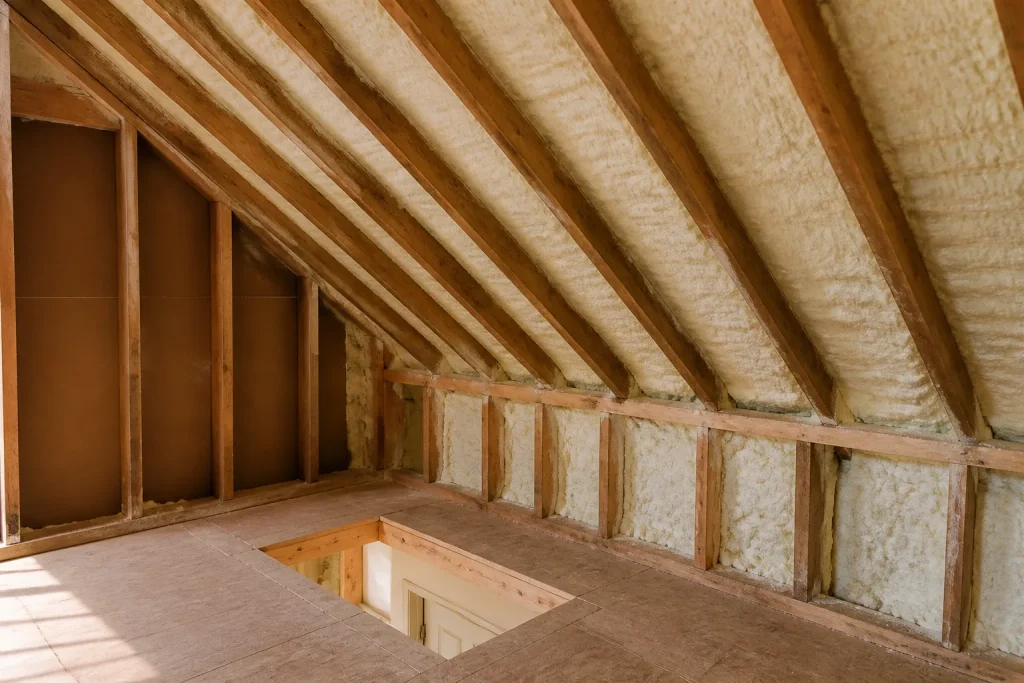
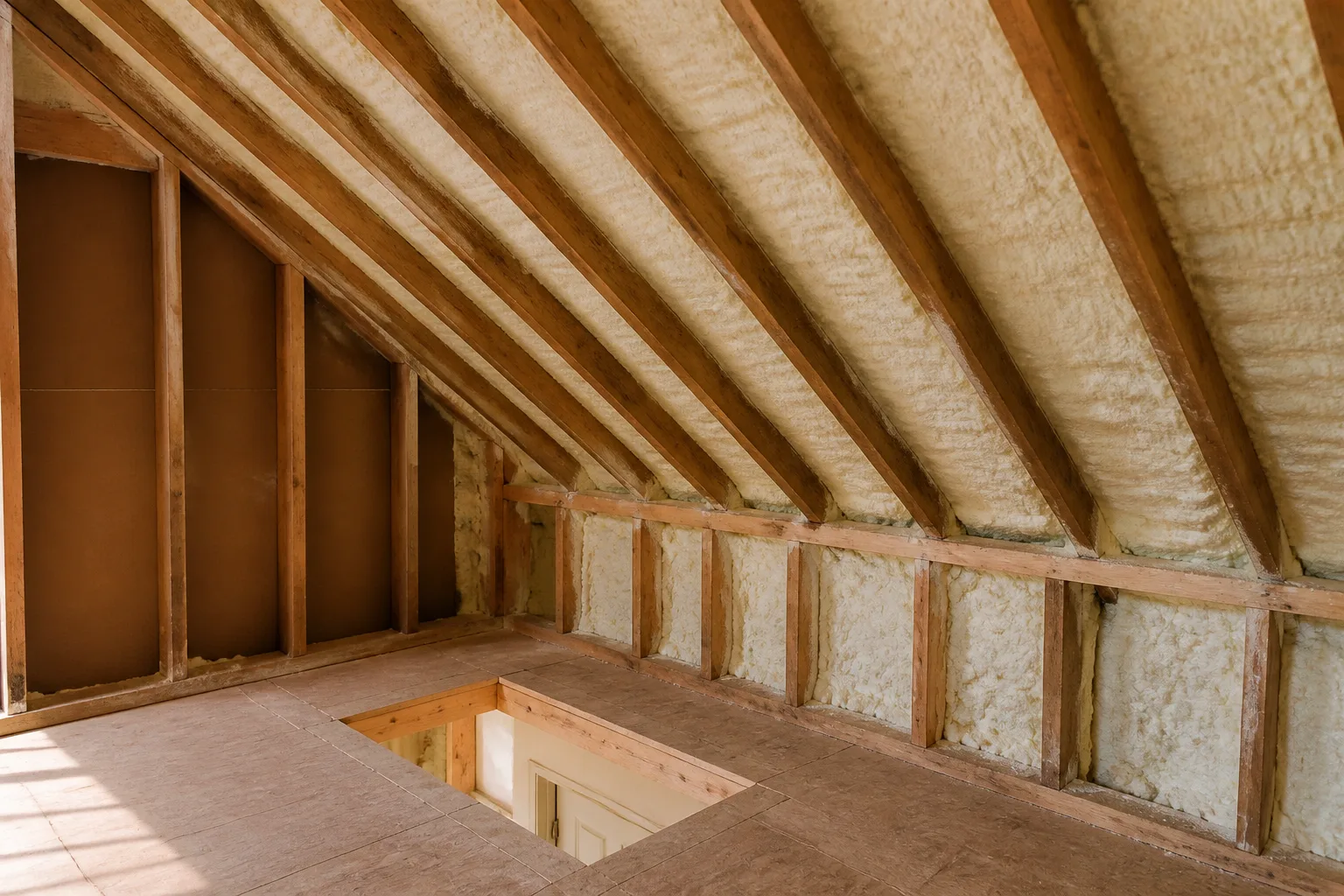
Demilec is a spray polyurethane foam manufacturer with two product families aimed at attics: Heatlok HFO, a closed-cell foam, and Sealection 500, an open-cell foam. Both are sprayed as liquids and expand in place, sealing gaps that batt insulation and blown fiberglass can’t reach. The brand matters because the two formulations behave very differently once cured, and a contractor locked into a single product line will recommend the same foam for every attic in Las Vegas whether it fits or not.
We install Demilec alongside Icynene because both companies make credible foam, and our job is matching the material to your attic rather than to what happens to be loaded on a rig. When we look at a Las Vegas attic, three things drive the foam choice:
- Whether the attic is vented or unvented. An unvented attic puts the roof deck inside your home’s thermal envelope, and that changes everything about moisture and temperature.
- How much thermal bridging you have. Wood trusses conduct heat around insulation rather than through it, and Las Vegas roof decks get genuinely hot.
- Whether vapor movement needs to be blocked or allowed. Dry desert air and conditioned living space below create a vapor gradient that the wrong foam can trap in the wrong place.
Get those three right and the foam works. Get them wrong and you’ve paid for a product that underperforms its own spec sheet.
Helatlok HFO vs. Sealection 500: how do the two Demilec foams compare?
HeatLok HFO is closed-cell foam, meaning it cures into a dense, rigid plastic with a high insulating value per inch and a built-in vapor barrier. Sealection 500 is open-cell, meaning it cures softer, breathes more, and insulates less per inch. Here’s the side-by-side that most quotes never show you:
| Property | Heatlok HFO (closed-cell) | Sealection 500 (open-cell) |
|---|---|---|
| Cell structure | Closed, rigid | Open, soft |
| Thermal performance per inch | Higher | Lower |
| Vapor permeability | Acts as a vapor retarder | Vapor-permeable |
| Air sealing | Excellent, plus structural stiffening | Excellent air sealing, no structural value |
| Best attic use | Unvented attic conversions, roof deck, thermal bridging at trusses | Vented attics, sound damping, complex cavities where foam volume matters |
| Blowing agent | Low-GWP HFO | Water-blown |
In our experience, homeowners searching for Demilec attic insulation in Las Vegas usually assume the closed-cell product is automatically better because it insulates more per inch. Not always. In a vented attic over a Las Vegas home, open-cell foam can be the smarter call because it lets the assembly dry. On a roof deck, closed-cell often isn’t optional.
Why do Demilec’s HFO blowing agents matter in Nevada?
Heatlok HFO uses hydrofluoroolefin blowing agents, which carry a much lower global warming potential than the older HFC chemistry that foam manufacturers are phasing out. If you’re chasing a green building certification on a new build or a deep renovation in Las Vegas, that distinction can matter to a third-party rater reviewing your assembly.
We won’t tell you a specific rebate amount, because we’d be guessing and you’d be stuck with a number that isn’t real. What we will say is this: any utility or certification incentive tied to foam is based on documented product data, so keep the manufacturer’s technical data sheet and the installer’s thickness and mixing records once the job is done. Those are the documents a program reviewer asks for. The building department, your utility, and your rater are the people who set the actual requirements. We check what applies to your home during the estimate rather than promising a figure up front.
The low-GWP angle is one reason Heatlok HFO shows up on more spec sheets for high-performance Las Vegas attics. It’s not the only reason. Performance comes first.
Which Las Vegas attic scenarios require closed-cell Demilec?
Three attic situations in Las Vegas almost always call for closed-cell foam, and in those cases the open-cell product won’t do the job no matter how thick it’s sprayed.
- Unvented attic conversions. When you seal off the soffit and gable vents and bring the roof deck inside the conditioned envelope, the deck becomes an interior surface. It needs a vapor-retarding, high-performance layer applied directly to it. Open-cell foam lets too much vapor through for most conversions.
- Direct-to-deck roof applications. Spraying foam onto the underside of the roof sheathing in a cathedral ceiling or a low-slope Vegas roof assembly is closed-cell territory. The foam has to hold up against extreme deck temperatures and block vapor from the living space below.
- Thermal bridging at the trusses. Wood trusses pass heat around the insulation rather than through it, and in a Las Vegas attic the difference shows up as hot ceiling drywall in the rooms below. Closed-cell foam bonds to the wood and the deck, breaking that bridge. Blown fiberglass laid over the ceiling plane can’t.
Every other attic is a judgment call. Vented attics, standard retrofits, and simple air-sealing jobs often get better value from open-cell foam or from a blown-in product. That’s the conversation worth having before anyone sprays anything.
What does a correct Demilec spray foam installation look like?
A correct Demilec install is measurable. If a crew can’t tell you how they verify thickness and mix ratio, the foam will underperform its rating no matter which product they spray.
- Substrate temperature check. Foam chemistry has a temperature window. Spraying onto a cold or damp substrate produces foam that looks fine and performs badly, so we measure before we spray.
- Thickness verification. Closed-cell foam is typically applied in thin passes and allowed to build. Depth gets checked with a gauge, not by eye, and the final thickness should match the plan.
- Off-ratio mixing is the silent killer. Demilec foam is a two-component system, and the A and B sides have to meet at the correct ratio. Off-ratio foam can come out tacky, brittle, or low-density while looking perfectly normal from across the attic. Proper equipment calibration before the first pass is what prevents it.
- Ventilation and PPE during application. Spray foam releases isocyanates while curing. A crew working in a Las Vegas attic in summer needs supplied air and proper ventilation, and the space shouldn’t be occupied during the cure.
One more thing worth knowing: spray foam is not a DIY material. The chemicals, the pressure equipment, and the cure requirements make it a job for a trained professional. We’d rather talk you out of a solo attempt than have you learn that the hard way. If you’d rather not tackle the project yourself, call (833) 863-9172.
How does Demilec spray foam compare in cost to blown fiberglass?
Demilec spray foam costs more up front than blown fiberglass at equivalent thermal performance in a typical 1,500 square foot Las Vegas attic, and the gap is real. Blown fiberglass is the cheaper material and the faster install. Spray foam delivers air sealing in the same pass, which often means it does more work than its thermal rating alone suggests.
Here’s how we’d frame the comparison:
- Blown fiberglass. Fast, less expensive per square foot, and a proven solution for a standard vented attic that needs more depth over the ceiling plane. It doesn’t air-seal, so gaps at penetrations still need to be handled separately first.
- Open-cell Demilec. Pricier than fiberglass, but it air-seals and insulates in a single application, which cuts down on a second visit and does more for a leaky attic in Las Vegas.
- Closed-cell Demilec. The highest installed cost of the three, and the only one that makes sense for an unvented conversion or a direct-to-deck application.
We quote from the conditions we see, so we won’t publish a price that won’t hold. Every quote is per job, in writing, and the estimate visit is free. That’s where the number comes from.
When should you call a pro instead of installing insulation yourself?
Call a professional when the attic needs air sealing alongside insulation, when you’re considering an unvented conversion, or when you want closed-cell foam at all. Spray foam is the obvious case because of the chemistry and equipment. But even blown-in and batt work is easy to get wrong in ways you won’t notice until August, when the ceiling is warm and the AC won’t shut off.
We’ve seen enough Las Vegas attics to know what a good install looks like versus one that only looks adequate from the ladder. Our technicians have up to 15 years of experience, and every recommendation starts with the attic conditions versus the product spec. If you want a second opinion on a quote, or you need a fresh one, Attic Insulation Las Vegas will look at your attic and tell you what it needs.
Related services in Las Vegas: attic insulation, spray foam insulation, and our broader Las Vegas service information.
The Bottom Line
Demilec gives you two products with real differences, and the decision between them should be based on your attic, not your installer’s inventory. Closed-cell Heatlok HFO is the right call for unvented conversions, direct-to-deck roof assemblies, and thermal bridging at the trusses. Open-cell Sealection 500 is often the smarter fit for vented attics and complex cavities. Blown fiberglass remains the budget-conscious choice when air sealing isn’t the priority. The best way to know which one your Las Vegas attic needs is a site visit, because nobody can spec foam from a phone description.
If you’re in Las Vegas and want a straight answer on your attic, Attic Insulation Las Vegas offers free estimates. Call (833) 863-9172. We answer 24/7. Fast dispatch from 7am to 7pm, Sunday through Friday.
Frequently Asked Questions
Neither is better across the board. Demilec’s Heatlok HFO and Icynene’s closed-cell products are both credible, and the right pick comes down to the specific attic. We install both and recommend based on the assembly, not the brand name. Call (833) 863-9172 for an exact quote on your attic. Estimates are free.
Closed-cell foam can be sprayed over existing fiberglass or cellulose on the roof deck in many cases, but it often needs to come out first so the foam bonds to a clean substrate. The answer depends on the assembly and the moisture history of the attic. The estimate visit is where that gets settled.
A typical attic job runs a day or two, depending on square footage, whether old insulation has to come out first, and which product you choose. Closed-cell foam goes on in thinner passes that take longer to build to spec. We set the schedule after the estimate, not before.
Spray foam can lower cooling costs by air sealing and insulating in one application, and it’s especially effective where roof decks and trusses drive heat into the living space. The actual result depends on your attic, your ductwork, and your HVAC setup, which is why we look at the whole picture before recommending a product. Call (833) 863-9172 for a free estimate.
Written by the team at Attic Insulation Las Vegas.
Need Insulation Help?
Call Attic Insulation Las Vegas - licensed & insured, here with fast help in Las Vegas.
(833) 863-9172